Saturday, March 29, 2025
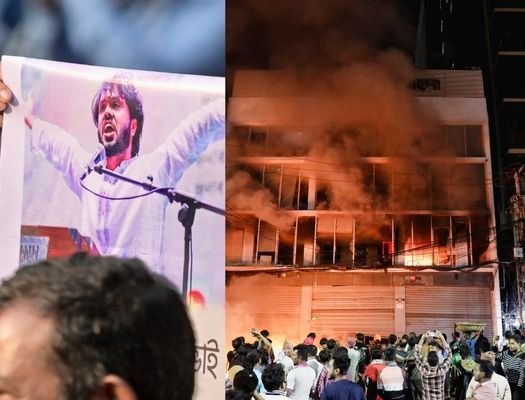
Dhaka: Bangladesh has once again been gripped by violence and political unrest following the death of Sharif Usman Hadi, a prominent face of the so-called “July Revolution” and spokesperson of the Inquilab Manch. Hadi passed away late Thursday night while undergoing treatment at a hospital in Singapore, triggering widespread protests, arson, and vandalism across the country.
On December 12, Usman Hadi was attacked in Dhaka’s Paltan area while travelling in an auto-rickshaw. Assailants riding a motorcycle intercepted the vehicle and shot him at point-blank range in the head. The attack left him critically injured.
He was initially admitted to Dhaka Medical College Hospital and later shifted to Singapore on December 15 for advanced treatment. Hadi remained in a coma for several days before succumbing to his injuries on Thursday night.
As news of Hadi’s death spread, supporters of Inquilab Manch, along with large numbers of youth, poured onto the streets, leading to a sharp escalation in tensions.
Attack on media house: Protesters stormed the Dhaka office of leading newspaper Prothom Alo and carried out extensive vandalism.
Political offices targeted: Several offices of the ruling Awami League were set on fire and damaged in different parts of the capital.
Road blockades: Inquilab Manch activists staged a sit-in at Shahbagh, effectively bringing traffic to a standstill. The group warned of a nationwide shutdown until those responsible for the attack are arrested.
Sharif Usman Hadi was a controversial and influential political figure in Bangladesh. He frequently made strong anti-India statements and openly demanded a ban on the Awami League. He was also preparing to contest upcoming elections as an independent candidate from a Dhaka constituency.
Following his death, Inquilab Manch has declared him an “Inquilabi Shaheed” (revolutionary martyr), further fueling emotions among his supporters.
Hadi’s body is expected to arrive in Dhaka from Singapore on Friday morning. Anticipating further unrest, authorities have deployed heavy police and security forces across sensitive areas of the capital. Despite this, the situation remains tense and volatile, with fears of more violence if demands for immediate arrests are not met.
The killing of Usman Hadi has once again exposed Bangladesh’s fragile political climate, raising serious concerns over law and order, freedom of the press, and escalating political violence.